



Destiny USA in Syracuse is the largest shopping and entertainment complex in New York State, drawing more than 26 million visitors a year. Stores here turn over steadily, and when a brand signs a lease the landlord calendar starts immediately: rent commences and the space is expected open by a fixed date. Plescia Construction & Development performs fast-track retail interior fit-outs at Destiny USA — overlapping design, procurement, permitting, and construction so a raw or existing space becomes an open, revenue-generating store as quickly as the mall’s schedule demands, without cutting corners on quality or code. The result our tenants care about is simple: a store that opens on the promised date and passes inspection the first time.
A brief history of Destiny USA
Destiny USA opened in 1990 as Carousel Center, developed by The Pyramid Companies under Robert Congel and named for an antique Philadelphia Toboggan Company carousel that still operates inside. The site itself is part of the story: it had been an industrial landfill ringed by oil tanks — the area known as “Oil City” — and required environmental remediation before the mall could be built on the shore of Onondaga Lake. In 2001 Pyramid announced a major expansion and rebranding; an 800,000-square-foot addition was completed and the property officially became Destiny USA in 2012.
Construction and development
Today Destiny USA is owned and operated by Pyramid Management Group and totals roughly 2.4 million square feet of gross leasable area — the largest shopping and entertainment complex in New York State — with around 240 stores, some eighteen anchors, and more than 26 million visitors a year. Its tenant mix is heavily weighted toward entertainment and dining, including a 19-screen Regal cinema with IMAX, WonderWorks, Dave & Buster’s, and an attached Embassy Suites hotel. The complex rises six levels, with an underground level, beside Onondaga Lake and is reached by Interstates 81 and 690. That size and multi-level, mixed-use character make understanding how a given space connects to the building’s structure, utilities, and fire-protection systems the starting point for any fast-track fit-out here.
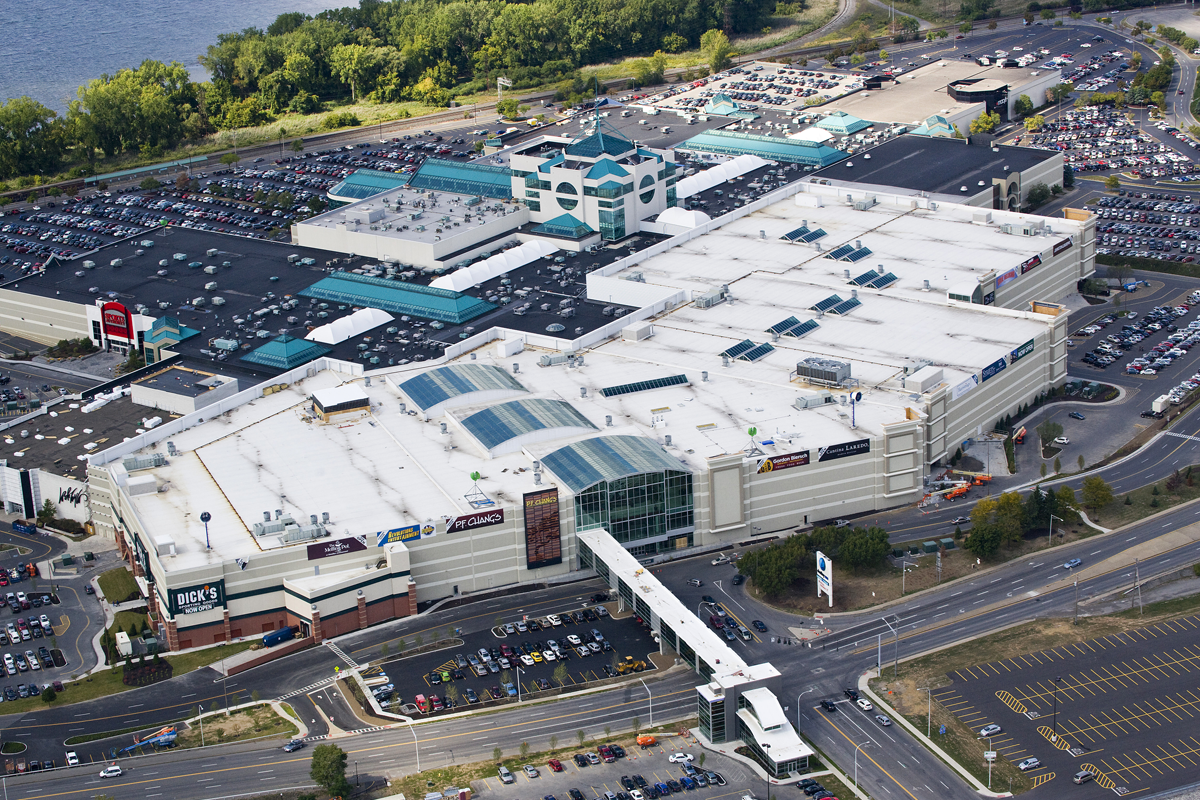
The intricacies of retail construction inside an occupied mall
Building a store inside a live mall is very different from ground-up work. The center stays open and full of shoppers throughout construction, so a fit-out at Destiny USA is governed as much by logistics and coordination as by the drawings. Plescia plans each project around the realities of an occupied, revenue-producing building:
- After-hours and night work for noisy, dusty, or common-area-impacting activity, phased so neighboring stores never have to close.
- Landlord “tenant criteria” standards — storefront lines, sign bands, closure barricades, and utility tie-in points follow the mall’s design-criteria manual, not just the tenant’s drawings.
- Temporary barricades and hoarding built to the mall’s graphic and safety standards, protecting shoppers and screening the work.
- Service-corridor and loading-dock logistics — deliveries, dumpsters, and material handling scheduled through shared docks and freight elevators in tight windows.
- Base-building tie-ins — sprinkler, fire alarm, HVAC, and electrical connections coordinated with the mall’s systems, often under supervised shutdowns.
- Hot-work permits and fire watch, dust and odor control, protection of common-area finishes, and constant housekeeping right up to the barricade line.
Sequencing all of this — not the raw construction — is usually what determines whether a store opens on time. Long-lead items like storefront glass, millwork, and specialty equipment are identified and ordered on day one, and the schedule is built backward from the landlord’s required open date.
Interfacing with the City of Syracuse
Destiny USA sits within the City of Syracuse on the Onondaga Lake shoreline, so permits and inspections run through the city’s code-enforcement office. The lakefront location and the site’s industrial past mean environmental and stormwater considerations can factor into work that touches the base building, and access is tied to Interstates 81 and 690 — the I-81 corridor through Syracuse being in the middle of a major reconstruction. Like most malls the complex also enforces a construction and delivery freeze through the peak holiday season. A realistic schedule here is built around the city’s process, the site, and the retail calendar.
Working with local building officials
All construction here is regulated under the New York State Uniform Fire Prevention and Building Code, with permits and inspections handled through the City of Syracuse code-enforcement office and its sub-code officials for building, electrical, plumbing, and fire. A retail build-out typically also involves separate sign permits, fire-subcode review of any sprinkler and alarm changes, and — for any restaurant or food tenant — health-department review of the food-service scope. A fast-track fit-out depends on keeping that whole process moving in parallel with the work: a clean, code-compliant permit set, quick resolution of plan-review comments, any required special inspections, rough and final inspections sequenced to the build, and a temporary certificate of occupancy so the store can open on the landlord’s date while final punch items close out. Plescia manages that permitting and inspection track directly and maintains the working relationships with local officials that keep it from becoming the bottleneck.
Coordinating with Destiny USA mall management
Every project at Destiny USA runs through Pyramid Management Group’s tenant-coordination process, which sits alongside the municipal permitting track and is just as important to hitting a date. Before a tool is on site, that means landlord-approved drawings, certificates of insurance meeting the mall’s required limits, a signed contractor rules-of-conduct agreement, and badging for every worker. During construction it means honoring approved work hours, staging and hoisting only where permitted, using designated docks and freight routes, protecting common-area finishes, removing waste on the mall’s terms, and coordinating any utility interruption with mall operations and security in advance. At closeout the landlord expects a clean turnover — inspections passed, barricade removed on schedule, and the space delivered show-ready. Plescia’s job is to make that coordination invisible to the tenant, carrying the landlord’s and the municipality’s requirements so the brand can focus on merchandising and opening.
How Plescia keeps a fit-out on the fast track
Speed on a mall build-out comes from process, not shortcuts. We begin procurement of long-lead items — storefront systems, custom millwork, specialty lighting and equipment — on day one, because those deliveries, not the labor, usually set the critical path. We run the permit application in parallel with the closeout of design instead of waiting for a fully finished set, and we build a milestone schedule backward from the landlord’s required open date so every trade, inspection, and delivery has a fixed slot. Night and weekend crews compress the work that has to happen while the mall is dark, and a single Plescia point of contact coordinates the tenant’s design team, the local building department, and mall management at the same time, so nothing sits waiting on a hand-off. Just as important, we surface problems early — a long-lead conflict, a code question, a landlord condition — while there is still time to solve them, rather than discovering them at final inspection.
Fast-track retail fit-outs at Destiny USA are one part of Plescia Construction & Development’s broader commercial general contracting practice, which spans multiple states and markets. The goal on every one is the same: a finished, code-compliant, inspection-ready store, open on the date the lease demands.
Frequently Asked Questions
Can Plescia build out a store while Destiny USA stays open?
Yes. We phase retail fit-outs at Destiny USA around the mall’s operating hours, performing noisy, dusty, or common-area work after hours and behind approved barricades so neighboring stores and shoppers are never disrupted.
Who handles permitting for a store build-out at Destiny USA?
Plescia manages the entire permitting and inspection process under the New York State Uniform Fire Prevention and Building Code through the City of Syracuse code-enforcement office and its building, electrical, plumbing, and fire sub-code officials, including any sign, fire-subcode, or health-department reviews, and drives toward the temporary certificate of occupancy needed to open.
What is a fast-track retail fit-out?
A fast-track fit-out overlaps design, procurement, permitting, and construction instead of running them in sequence, and orders long-lead items immediately, so a leased space becomes an open, inspection-ready store in the shortest possible time — the approach a mall like Destiny USA requires to hit landlord open dates.
How does Plescia coordinate with Destiny USA mall management?
We work through Pyramid Management Group’s tenant-coordination process — landlord-approved drawings, certificates of insurance, contractor rules of conduct, worker badging, designated docks and freight routes, and scheduled utility shutdowns — so the landlord’s requirements are met without slowing the tenant’s opening.
How does the entertainment mix at Destiny USA affect a fit-out?
Destiny USA is heavily weighted toward entertainment and dining across multiple levels, so retail spaces sit among cinemas, attractions, and restaurants. That mix makes logistics, phasing, and coordination with mall operations the biggest drivers of a successful fast-track fit-out.
Who owns and manages Destiny USA?
Destiny USA is owned and operated by Pyramid Management Group, which developed it as Carousel Center in 1990. We coordinate each fit-out through Pyramid’s tenant-coordination process.